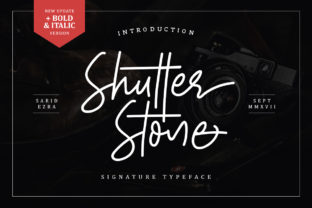
The Personal Signature: Unlocking Brand Identity with Shutter Stone Typeface
In a digital world saturated with polished, impersonal fonts, the handwritten signature stands apart as a mark of individuality and commitment. It is a deeply human gesture, conveying authenticity, trust, and a personal touch. Translating this powerful symbol into a functional digital asset presents a unique challenge for designers seeking to infuse their work with genuine character. This is where a specialized handwritten signature typeface becomes a critical tool. The Shutter Stone typeface is engineered to meet this need, offering a cohesive yet organic set of characters that emulate the fluidity and elegance of a personal hand.
The Anatomy of a Signature Font
Unlike standard script fonts that often aim for perfect uniformity, a signature typeface must balance consistency with controlled variation. It is designed not to look machine-made, but to replicate the natural inconsistencies of pen on paper. The letterforms in such a font exhibit subtle differences in stroke weight, slight variations in baseline alignment, and unique ligatures that connect characters as a human hand would. This creates a rhythm across words that feels observed rather than constructed. The Shutter Stone typeface, for instance, incorporates these nuances, providing a set of glyphs that work together to form a believable signature style without requiring custom illustration for every project.
Key Characteristics of a Handwritten Signature Style
Several defining features separate a true signature font from mere decorative scripts. First is the flow and connectivity. Letters are designed to link naturally, with entry and exit strokes that guide seamlessly from one character to the next. Second is the controlled imperfection. A perfect oval ‘o’ or a perfectly straight ‘l’ feels computerized; a signature font introduces minute wobbles, tapered endings, and uneven curves that mimic natural handwriting pressure. Third is the authoritative weight. A signature typically carries a visual weight—it is bold and deliberate, meant to be seen and recognized. The Shutter Stone embodies this through its confident stroke presence, ensuring the signature stands out as a focal point.
Practical Applications Beyond the Signature Line
While the obvious use is for digital signing or logo creation, the applications of a handwritten signature typeface are remarkably broad. Its utility stems from its ability to convey human authenticity in contexts where standard corporate fonts fail.
Elevating Brand Personal Touchpoints
For businesses, especially in service-oriented industries like consulting, law, or bespoke craftsmanship, using a signature-style font on direct communication can transform perception. An email disclaimer, a thank-you note on a receipt, a personalized quote document, or even a watermark on proprietary materials—all can be rendered with the Shutter Stone typeface to imply a direct, personal endorsement from the founder or principal. This subtly reinforces that there is a real person behind the brand, building trust and rapport.
Enhancing Creative Project Authenticity
Artists, authors, and content creators can use this font style to add a curator’s mark to their work. An author’s name on a book cover rendered with Shutter Stone feels more like a direct autograph. A filmmaker’s credit in a signature style on a poster adds a layer of personal authorship. For wedding photographers or event planners, using the font on invitations, timelines, or final deliverables can mirror the handwritten elegance of traditional stationery, bridging digital convenience with analog warmth.
A Tool for Educators and Researchers
In academic or educational materials, where authority and provenance are key, a signature font can be used to highlight key contributions, sign off on official letters of recommendation, or denote original source annotations. It provides a visual cue that certain elements carry the weight of personal expertise or endorsement, distinguishing them from general body text.
Integrating Signature Typography into Design Workflows
Incorporating a font like Shutter Stone requires a shift in thinking from purely functional typography to expressive typography. It is not a font for long paragraphs of body text. Its role is typically accentual or declarative.
Successful implementation follows a few guiding principles. First, use it sparingly. Its power lies in its rarity within a layout. Overuse dilutes its impact and can make a design feel cluttered or inconsistent. Second, pair it strategically. A signature font needs a strong, clean supporting font for other text elements. Simple sans-serifs or classic serifs provide a stable foundation that allows the handwritten style to shine without conflict. Third, consider context and color. Often, rendering the signature type in a single color, or even in a subtle gradient that mimics ink, enhances its realism. Avoid over-complicating it with excessive filters or effects that undermine its core authenticity.
Navigating Considerations and Potential Challenges
Choosing and using a handwritten signature typeface involves specific considerations. Legibility, while not the primary goal for a true signature, must still be maintained for any functional use where the text needs to be read clearly. The Shutter Stone typeface is crafted to balance artistic flourish with clear character recognition. Another consideration is cultural and industry appropriateness. In some very formal or highly regulated fields, a handwritten style might be perceived as too casual for official documents; understanding the audience’s expectations is crucial.
From a technical standpoint, ensuring the font renders correctly across all media is key. Testing its appearance on web (using proper @font-face implementation), in print, and on mobile devices is essential, as the fine details of the stroke variations can be lost on low-resolution screens if not optimized. Furthermore, while the font provides a unified style, it may not replace a truly custom-drawn signature for a specific individual’s legal or brand logo use. Its strength is in providing a style—a coherent, elegant handwritten aesthetic that can be applied broadly by a brand or creator.
The Broader Trend: Humanizing Digital Communication
The demand for tools like handwritten signature typefaces aligns with a larger movement in design and branding: the rejection of sterile digital perfection in favor of human-centric elements. Consumers and clients increasingly value authenticity and connection. In an interface or a brand identity, elements that suggest human effort and personality foster greater engagement and trust. The Shutter Stone typeface, and fonts of its category, are direct responses to this trend. They are not nostalgic throwbacks, but functional assets enabling designers to embed a sense of personal commitment and craftsmanship into digital spaces.
This trend extends from logos to UI design, where subtle handwritten notes in apps can guide users more warmly, to marketing materials that seek to break through the noise of generic advertising. The signature style acts as a visual shorthand for “this is personal, this is cared for, this is real.”
Future Implications for Creators
As this preference for human-touch design grows, the versatility of a reliable signature font will likely expand. We may see its increased use in dynamic contexts—for instance, in variable font implementations where the weight or connectivity can adjust subtly based on context, or in augmented reality environments where a digital signature needs to overlay a real-world scene with convincing authenticity. For the independent creator, the small business owner, or the design professional, having access to a well-crafted tool like Shutter Stone provides a competitive edge. It allows the scaling of a personal touch across multiple touchpoints without sacrificing consistency or requiring constant custom artwork.
Ultimately, the value of a handwritten signature typeface lies in its translation of a profound human gesture into a repeatable design element. It captures the elegance and striking presence of a signature, making that style accessible for branding, communication, and creative expression. By understanding its characteristics, applications, and thoughtful implementation, designers and communicators can harness this tool to create work that resonates more deeply, stands out more distinctly, and communicates not just information, but identity and intent.